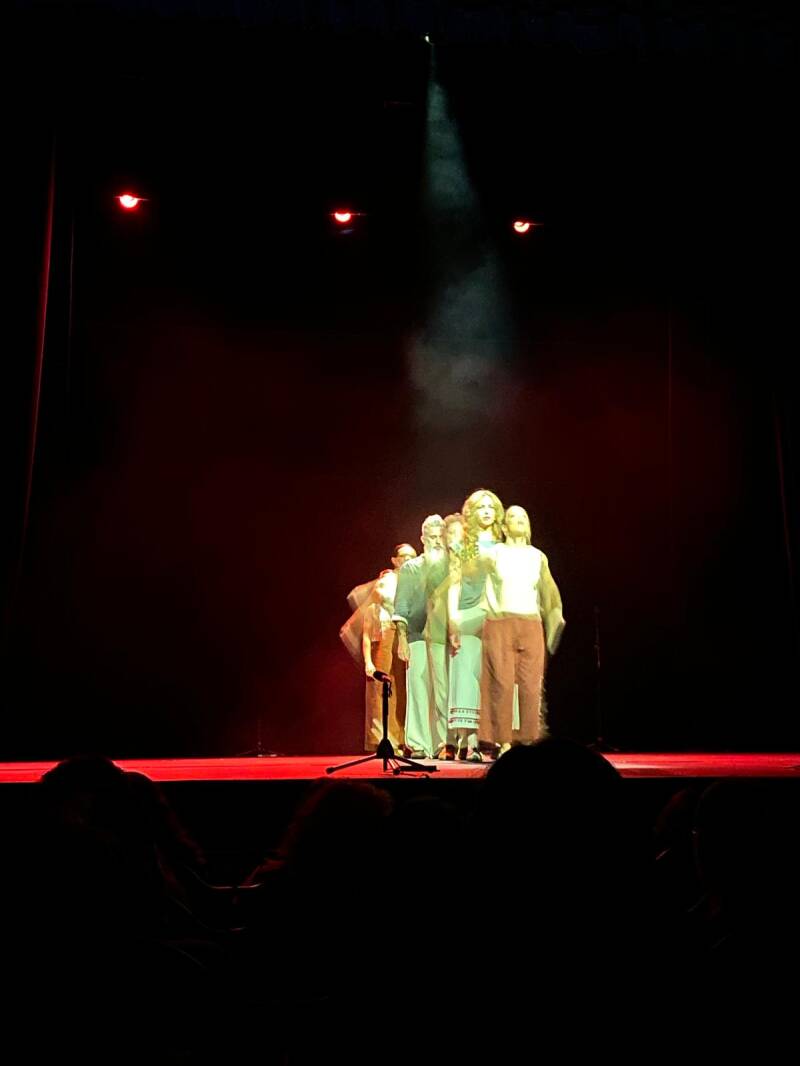
Boditteranean is an innovative performance by a group of Greek and Italian artists led by Music Anthropologist and percussionist Simone Mongelli.
The performance is featured by a set of artists 's hands clapping in personal diverse bodily parts so to create an harmonious rhythm that sings also without the accompaniment of traditional musical instruments. The artists movs and sings in rhythm to his own clapping of hands in the body. The sections of performance featured different scenarios in relation to love, migration, sea, happiness , motherhood. In the movement of their bodies and in the singing of poems, the performers dig into the. profound art of intercultural storytelling. The name Boditerranean is a mix between Body and Mediterranean , properly to give homage to the importance of the body as a site of encounter with the different cultures of the Mediterranean.
'Tradition becomes the spark that unveils hidden emotions and serves as a starting point for the collective affirmation or the personal questioning of social values'.
One of the many touching my heart was the harmonious poetry of Aremu Rindineddha- it is a poem about emigration and homesickness, from the area of Salento , Puglia, arranged towards the end of the 19th century, in the Griko language, a greek based dialect slowly disappearing , which originate in the years of Magna Grecia . The poem goes like this :
Who know , my little swallow,
which sea is bringing you,
and where you came from
with such a nice weather.
Your chest is white,
your wings are black,
your spine has the colour of the sea,
and your tail is cut into two.
Sitting on the shore,
I stare at you.
You lightly bend, lightly drop,
lightly skim the water.
Who know through which countries
you must have passed,
who knows where
you built your own nest.
Alas, if knew that you passed
through the place I came from,
I would ask you to tell me
as many things as you can.
But you do not utter a word ,
as much as I ask you.
You lightly bend, lightly drop,
lightly skim the water.
Another poetic work that harmoniously celebrates the power of women in their self-determination and emancipation is Hemmhekk Inkun. The song reflects on the idea of the “matriarchive” — the notion that, although women’s experiences throughout history have not always been formally preserved, they endure through maternal memory, voice, and presence. It envisions the womb and the mother as spaces where history, loss, and continuity are quietly held, transformed, and transmitted across generations.
The powerful theme of matriarchy is further expressed through the central performance of an elderly Maltese woman, who embodies the mother of the land and its ancestral power to sustain and preserve feminine energy within the landscape.
Credits to the cast and creative team
Simone Mongelli
Sissy Pintela
Fotis Fotopolous
Spyridoula Baka
Danai Stergiou
Georgia Vardoulaki
Danai Politi
Guest Singers
Doreen Galea
Mariele Zammit