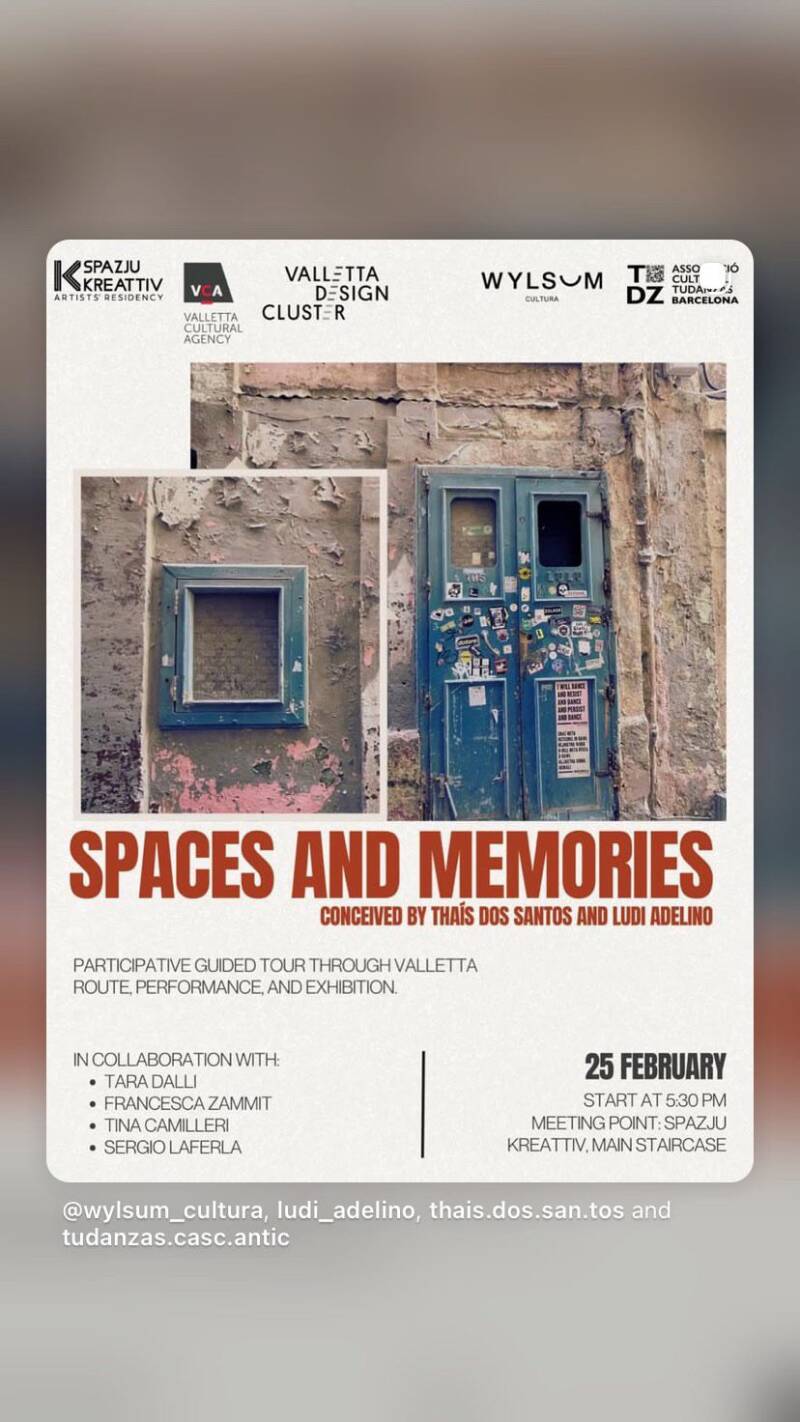
Creative -Artistic walk
The artistic residency by the 2 Spanish girls, showcased a series of performances held through a walk from Spaziu kreattiv to Valletta Design Cluster. The walk reflected on the thematic of spaces and memory and of how through space we can redefine the borders of our memory. The large headquarter of Valletta, with its large as wells well as narrow 'streets (topoi) served as a space to reclaim the identity of its cohabitants: an identity , which at times in history, has felt shacking more than still, due to its many invaders. Along these lines, the walk proceeded under the background of city noises and recordings of voices from local people who narrated particular tellings about valletta in times and spaces. When such recordings stopped, the walk carried on silently within the narrow vehicles, which at times happened to face the big harbour .
'Bocci club' performance
Yet the very first impressive stop was a bocci club , almost in front of fin Danza company. Initially the participants were to room around the sandy space, while asked to be invited. Just perceive the environment with its noises , colour or perfumes and sensations, while listening to almost nostalgic poem, narrating on mother land's memory. Later on , in the same space, a performer asked us to have a sit in the blu bench on the sides of the bocci club.. A blu haired black performer, started walking while observing the seated and muttering a 'mh sound' as a soundscape. Then she took a small bucket containing a power of scissors, that could lately help the seated ones to cut a piece of her hair, to be later stored in the bucket at the centre. I believe the main topic of such a laboratory was striving to protect your identity in the place where you were born despite the series of cultural changes that the place might have in time and space or perhaps attempting to go with the flow letting the surrounding change you but not your deepest core.
Identity and Nostalgia in front of the sea
The following workshop was held in front of Zfin Malta, on the seafront leading to the old houses opposite the port. The participants were invited to listen to a poem with the visual background of an artefact that went round itself through the wind. The Maltese artist began reading a poem in relation to "home" and feelings of nostalgia for its "authentic intact remains." What is it that makes ‘Malta’ truly Malta? Is it its language, its food, its history, its architecture, or is it simply its strategic geopolitical position in the Mediterranean that allowed all the previously mentioned components to be shaped by foreign invasions? The question is: did the strategic location in the Mediterranean help make Malta a historical and cultural land, or did the appearance of its strategic location downgrade its authenticity due to foreign invasions that literally gave this place an identity. Here one can come to think what it is that makes Malta truly Malta? What would have been of Malta without its ‘colonizers’? The workshop reflect on the theme of what it means to be born and raised in a country you could hardly ever feel like your "authentic home" because of "others".
Living the 'now' moment in the alive Strada Stretta
The following performance was held by the dancer Tara Dalli in 'Strada Stretta'. Participants were invited to set themselves aside in a very quite corner of stared stretta to gaze at the body movement of the dancer in that very narrow, old and quite piece of street. The artist was seated far away on a small step of an hold house. She then started moving philosophically in the street: running, escaping the tightness of the walls while miming the climbing of old houses windows , seating promptly on steps of Strada Stretta and eventually running away in the perpendicular street from one corner and then on the other, as if escaping something or running towards something. The movements that involved a lot of her body gesticulations were speedy at times performed in slow motions so to catch the fleeting of time despite the stillness of the 'topoi'. That was the main intention of the artist to truly convey the 'lived now moment' away from the chaotic night life rumours of few meters uphill the same road. Tara, through an interplay of fast and soft body movements in the space, managed to philosophically convey the true authentic experience of the 'live the NOW and present immediate moment'.
Moreover it seemed also to convey nostalgic feelings of how time flies and space can remain intact despite the passing of years. How can we turn back to our past childhood through a bodily experience of that old space'. How can we bring back to life past memories in the present moment and in the future through our movement in the space. The way one experiences space through its body can really redraft constantly the layers of a past, perhaps nostalgic, perhaps too close to us or too far away, allowing it to be lived in the present and shaping our conception of it in the future.
Final Remarks about the cultural / artistic walk in Valletta Design Cluster
The whole exhibition ended up in Valletta Cluster Design, where the inviters were urged to reach the last floor of such an architecture, for the final showcasing in crafting and artefacts of the artistic and cultural walk. A selection of pictures of Strada Stretta and old Valletta with random captions on their back meaningfully reflecting on them were hanging on one side of the wall. In the main central table a visual showcasing of pictures from the tradition of Carnival and from a typical Strada Stretta lifestyle of the '800 '900 centuries. In relation to the Carnival , participants jotted down a sentence in the wall which would remind them of what it means for them. I personally consider Carnival 'a reflex of society in parody'. The space also showcased a visual projection of one of the artist wearing a white carnival dress and dancing in the inner spaces of the old houses of Valletta, facing the harbour. In the outside of the room, there was a table and on it a large woody mosaic composed by fragments with written sentences of the voices of local inhabitants testimonials of Valletta.
Author’s Note: This article is intended as a personal reflection and philosophical analysis of the work of ludi Adelino, from Wylsum Cultura, and Thais Dos Santos, from Tudanzas Cultural Association, both based in Barcelona-Spain. . All references to the original work are made solely for the purpose of celebration and constructive critique of the performance. All rights to the work belong to its respective authors.
The residency Programm was organised by Spazju Kreattiv - Malta's National Center for Creativity, a vibrant cultural hub where heritage meets contemporary artistic expression in collaboration with Valletta Design Cluster - A vital community space for creative and cultural practice in Valletta
Date- 25th of February 2026
Version Italiana
Riflessioni su Spazio e Memoria: Una Residenza Artistica a Valletta
La residenza artistica delle due ragazze spagnole ha presentato una serie di performance itineranti, svoltesi lungo un percorso che da Spaziu Kreattiv ha condotto al Valletta Design Cluster. Il cammino ha offerto una riflessione sulla tematica degli spazi e della memoria, e su come, attraverso lo spazio, sia possibile ridefinire i confini dei nostri ricordi. La maestosa sede di Valletta, con le sue strade (topoi) tanto ampie quanto strette, è servita come luogo per rivendicare l'identità dei suoi coabitanti: un'identità che, in certi momenti della storia, è apparsa più vacillante che salda a causa delle numerose invasioni subite.
Lungo queste linee, la passeggiata è proseguita accompagnata dai rumori della città e dalle registrazioni di voci di persone locali, che narravano particolari racconti su Valletta in tempi e spazi diversi. Quando le registrazioni cessavano, il cammino proseguiva silenziosamente tra i vicoli stretti, che a tratti si affacciavano sul Porto Grande. Tuttavia, la prima tappa davvero suggestiva è stata un club di bocce, situato quasi di fronte alla compagnia di danza ŻfinMalta. Inizialmente, i partecipanti dovevano aggirarsi nello spazio sabbioso, chiedendo di "essere invitati". L'obiettivo era percepire l'ambiente con i suoi rumori, colori, profumi e sensazioni, ascoltando al contempo una poesia quasi nostalgica sulla memoria della terra natia.
Successivamente, nello stesso spazio, una performer ci ha invitati a sederci sulla panchina blu ai lati del club. Una performer nera con i capelli blu ha iniziato a camminare osservando i presenti, mormorando un suono ("mh") come tappeto sonoro. Ha poi preso un piccolo secchiello contenente un paio di forbici, che in seguito avrebbero aiutato i presenti a tagliare una ciocca dei suoi capelli, da riporre poi nel secchiello al centro. Credo che il tema principale di questo laboratorio fosse lo sforzo di proteggere la propria identità nel luogo in cui si è nati, nonostante i cambiamenti culturali che il luogo può subire nel tempo e nello spazio, o forse il tentativo di seguire il flusso, lasciando che l'ambiente ci cambi senza però intaccare il nostro nucleo più profondo.
Identità e Nostalgia di fronte al Mare
Il laboratorio successivo si è tenuto di fronte a ŻfinMalta, sul lungomare che conduce alle vecchie case opposte al porto. I partecipanti sono stati invitati ad ascoltare una poesia avendo come sfondo visivo un manufatto che ruotava su se stesso grazie al vento. L’artista maltese ha iniziato a leggere una poesia legata al concetto di "casa" e ai sentimenti di nostalgia per i suoi "resti autentici e intatti".
Cosa rende "Malta" veramente Malta? È la sua lingua, il suo cibo, la sua storia, la sua architettura, o è semplicemente la sua posizione geopolitica strategica nel Mediterraneo che ha permesso a tutte queste componenti di essere modellate dalle invasioni straniere? La domanda è: la posizione strategica nel Mediterraneo ha aiutato Malta a diventare una terra storica e culturale, o ha declassato la sua autenticità a causa delle invasioni che hanno letteralmente "imposto" un'identità a questo luogo? Qui si giunge a riflettere su cosa sarebbe stata Malta senza i suoi "colonizzatori". Il workshop ha riflettuto sul significato di nascere e crescere in un paese che difficilmente si può sentire come una "casa autentica" a causa degli "altri".
Il Movimento del Presente in Strada Stretta
La performance successiva è stata curata dalla danzatrice Tara Dalli in Strada Stretta. I partecipanti sono stati invitati a disporsi in un angolo molto tranquillo della via per osservare il movimento del corpo della ballerina in quel tratto di strada così stretto, antico e silenzioso. L'artista era seduta in lontananza sul gradino di una vecchia casa. Ha poi iniziato a muoversi filosoficamente per la strada: correndo, sfuggendo alla strettezza delle pareti, mimando l'atto di arrampicarsi alle finestre delle vecchie case, sedendosi prontamente sui gradini e infine scappando nella strada perpendicolare, come se fuggisse da qualcosa o corresse verso qualcosa.
I movimenti, caratterizzati da una ricca gestualità corporea, erano a tratti veloci e a tratti eseguiti in slow motion, quasi a voler catturare lo scorrere del tempo nonostante l'immobilità del topos. L'intenzione principale dell'artista era trasmettere l'esperienza autentica del "momento vissuto ora", lontano dai rumori caotici della vita notturna a pochi metri di distanza. Tara, attraverso un gioco di movimenti corporei rapidi e morbidi, è riuscita a trasmettere filosoficamente la vera esperienza del "vivere il QUI e l'ORA".
Inoltre, la performance sembrava trasmettere sentimenti nostalgici su come il tempo voli mentre lo spazio rimane intatto nonostante il passare degli anni. Come possiamo tornare alla nostra infanzia attraverso un'esperienza corporea di quel vecchio spazio? Come possiamo riportare in vita i ricordi passati nel momento presente e nel futuro attraverso il nostro movimento nello spazio? Il modo in cui si vive lo spazio attraverso il corpo può ridefinire costantemente i livelli di un passato — forse nostalgico, forse troppo vicino o troppo lontano — permettendogli di essere vissuto nel presente e plasmandone la nostra concezione futura.
La Conclusione al Valletta Design Cluster
L'intera esibizione si è conclusa al Valletta Design Cluster, dove gli invitati sono stati sollecitati a raggiungere l'ultimo piano per la presentazione finale di manufatti e opere artigianali del percorso artistico. Su una parete era appesa una selezione di foto di Strada Stretta e della vecchia Valletta, con didascalie casuali sul retro che riflettevano profondamente su di esse.
Sul tavolo centrale, una vetrina visiva mostrava immagini della tradizione del Carnevale e dello stile di vita tipico di Strada Stretta tra il XIX e il XX secolo. In relazione al Carnevale, i partecipanti hanno annotato sul muro una frase che rappresentasse ciò che esso significa per loro. Personalmente, considero il Carnevale "un riflesso della società in parodia". Lo spazio ospitava anche la proiezione video di una delle artiste che, indossando un abito da carnevale bianco, danzava negli spazi interni delle vecchie case di Valletta rivolte verso il porto. All'esterno della stanza, su un tavolo, si trovava un grande mosaico di legno composto da frammenti con scritte le testimonianze degli abitanti locali di Valletta.
Nota dell'autore: Questo articolo è inteso come una riflessione personale e un'analisi filosofica del lavoro di Ludi Adelino (Wylsum Cultura) e Thais Dos Santos (Tudanzas Cultural Association), entrambe con sede a Barcellona, Spagna. Tutti i riferimenti all'opera originale sono fatti esclusivamente a scopo di celebrazione e critica costruttiva della performance. Tutti i diritti dell'opera appartengono ai rispettivi autori.
Il programma di residenza è stato organizzato da Spazju Kreattiv – Centro Nazionale per la Creatività di Malta, in collaborazione con il Valletta Design Cluster.
Data: 25 febbraio 2026