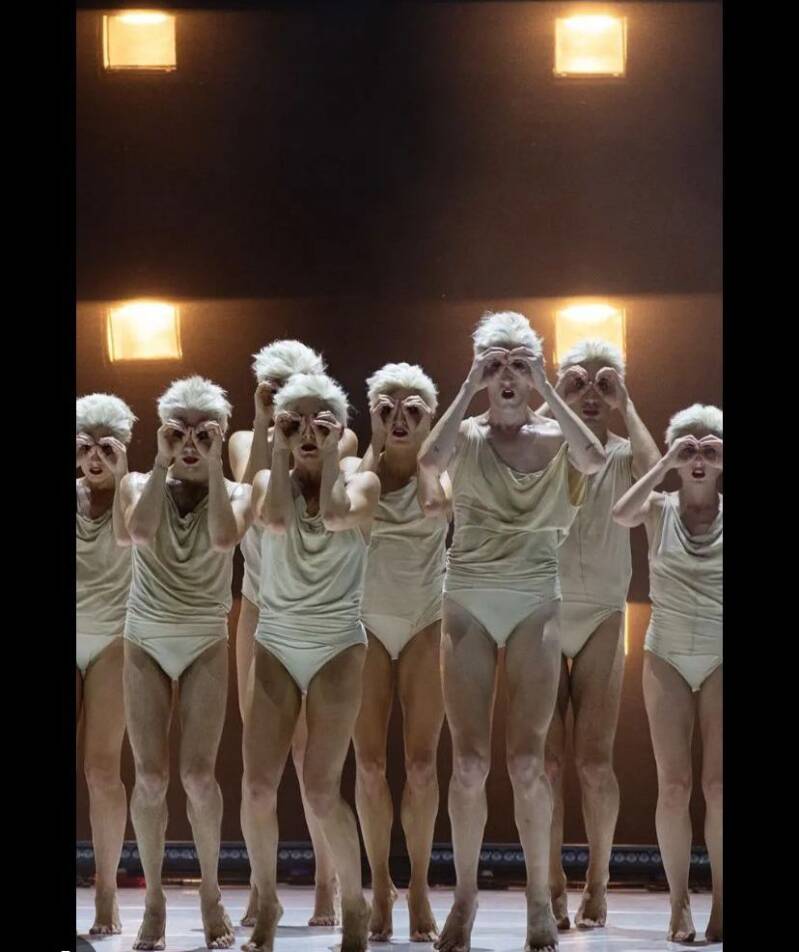
Inspired by 'The Little Match Girl Passion'
Inspiration for this creation—following an opening that highlights the care of the body through pieces of folk music—comes from the marvelous atmospheres of David Lang’s 2007 work The Little Match Girl Passion, winner of the Pulitzer Prize in 2008. These voices give life to a work of great sonic impact with sacred atmospheres, originally inspired by Hans Christian Andersen’s fairy tale, which certainly finds a reference in J.S. Bach’s St. Matthew Passion. In this creation, there is no mention of Andersen’s tale; instead, abstract, pure dance takes center stage as the absolute protagonist.
Inspiration reaches Zappalà indirectly from Bach’s masterpiece and from the concept of "passion" as the extreme suffering that Christ and every human being—every man, every woman, every "little match girl"—carries within. It is a journey of various stages, transits in motion where the dancers' bodies traverse and immerse themselves in states of abandonment, tenderness, joy, and ecstasy. Of poetry.
In Cultus, the physicality of the dance and its ability to transcend the referential allows the spectator to navigate a "fluid" space, losing all sense of time while simultaneously feeling part of something deeply moving in a single sensory experience. The bodies of the dancers, men and women, surrender to continuous movement and, through their relationships, bring to the stage the "passions" of both the individual and the multitude.
By using the medium most suited to choreographic elaboration—the human body—the creation fully integrates into the Transiti Humanitatis project, which has defined Roberto Zappalà’s artistic journey for many years.
I believe the purpose of this performance was to highlight the importane that dance, poetry , and socio cultural connotations can have for each one of us. For instance it started with the performers wearing each one a coloured wig and a nude colours leotard . Each one of them started to move in the dance floor under the rhythm of a recited poetry that expressed the voracity of the poetry danced by the dancer. And then so on simultaneously later..
Italian Version
A ispirare questa creazione -dopo un inizio che mette in risalto la cura del corpo con alcuni brani di musica popolare - sono le meravigliose atmosfere dell'opera The Little Match Girl Passion di David Lung composta nel 2007 e vincitrice del premio Pulitzer nel 2008 ; voci che danno vita ad un lavoro di grande impatto sonoro con atmosfere sacre originariamente ispirate alla fiaba della piccola fiammiferaia di Hans Christian Andersen , e che certamente hanno un riferimento nella Passione secondo Matteo di J.S. Bach. Nella creazione non si fa alcun cenno alla fiaba di Andersen, sarà la danza astratta , pura , ad essere protagonista assoluta.
L'ispirazione arriva a Zappalà indirettamente anche dal capolavoro di Bach e dalla passione come sofferenza estrema che Cristo e l'uomo, ogni uomo , ogni donna , ( ogni piccola fiammiferaia )porta con se. Un viaggio di varie tappe , transiti in movimento dove i corpi dei danzatori attraversano e si immergono nei vari stati dell'abbandono , della tenerezza , della gioia, dell'estasi . Della poesia.
In Cultus la fisicità della danza , il suo trascendere il referenziale , fa navigare lo spettatore in un luogo 'fluido' dove perdere la cognizione del tempo e contemporaneamente sentirsi partecipi di qualcosa di appassionante , in un'unica esperienza sensoriale. I corpi dei danzatori , donne e uomini , si abbandonano ad un movimento continuo e attraverso le loro relazioni portano in scena le' passioni ' dei singoli e delle moltitudini.
Usando il 'mezzo 'che piu si addice ad una elaborazione coreografica, il corpo umano, la creazione si inserisce a pieno titolo nel progetto Transiti Humanitatis che da molti anni caratterizza il percorso artistico di Roberto Zappala.
Author’s Note: This article is intended as a personal reflection and philosophical analysis of the work of [ Roberto Zappala, Compagnia di danza Zappala ]. All references to the original work are made solely for the purpose of celebration and constructive critique of the performance. All rights to the work belong to its respective authors.
Performance attended on: [30-11-2025] > Venue: [ Cango, Cantieri Goldonetta ]